Find the sensitive data in every source, and say how sure you are
A read-only harvest lists every table, column, row count and grant. The classifier gives each column a data class, a confidence and its reasons, from three signals. The close calls go to a person, with masked samples.
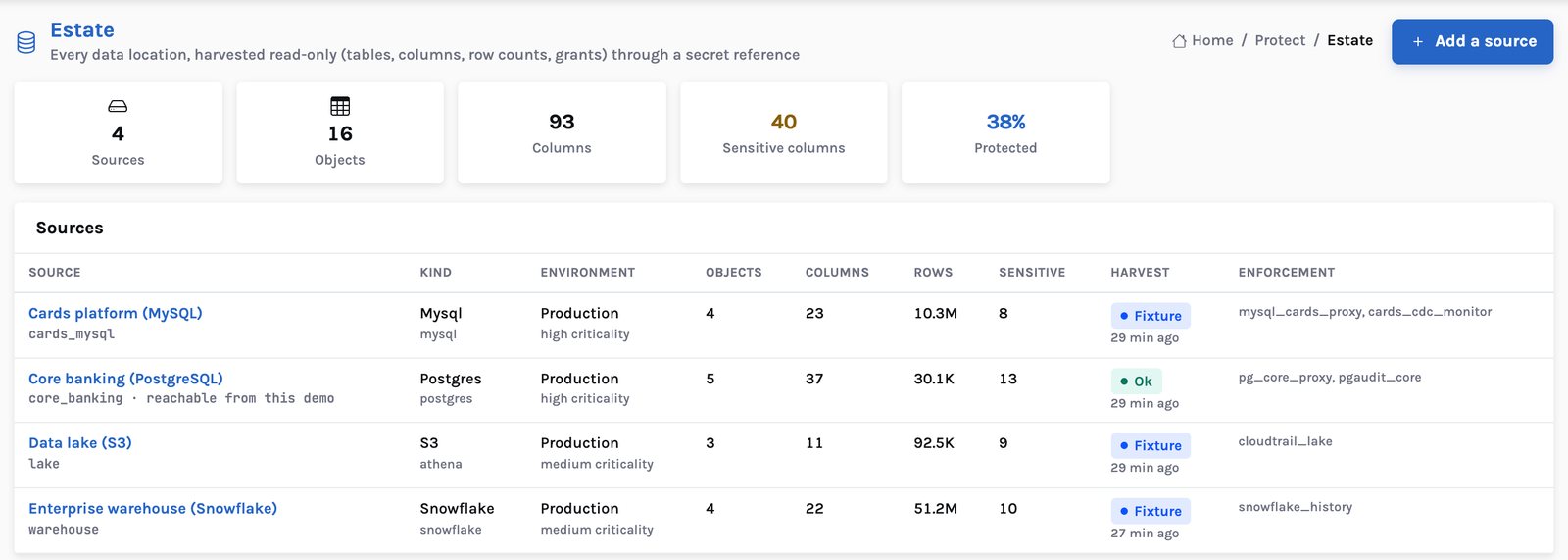
Tables, columns, row counts and grants, through a secret reference
Each source is a location with an owner, a business unit and a criticality. Its credentials are a reference to your secret store (env://, aws-sm://, aws-kms://); a harvest runs catalogue queries in a read-only session with a statement timeout. What a source stops reporting is set aside, and a person’s classification is kept.
- Grants included — every ACL entry and role membership, so access reviews start from what is really granted
- Read-only by construction — catalogue queries and bounded samples; nothing else is run
- Recorded fixtures for the demo — Northmere’s warehouse, cards database and lake are recorded catalogues; core banking is a live PostgreSQL
- Coverage at a glance — sources, objects, columns, sensitive columns and the share protected
Names, validated values and types, combined into a confidence
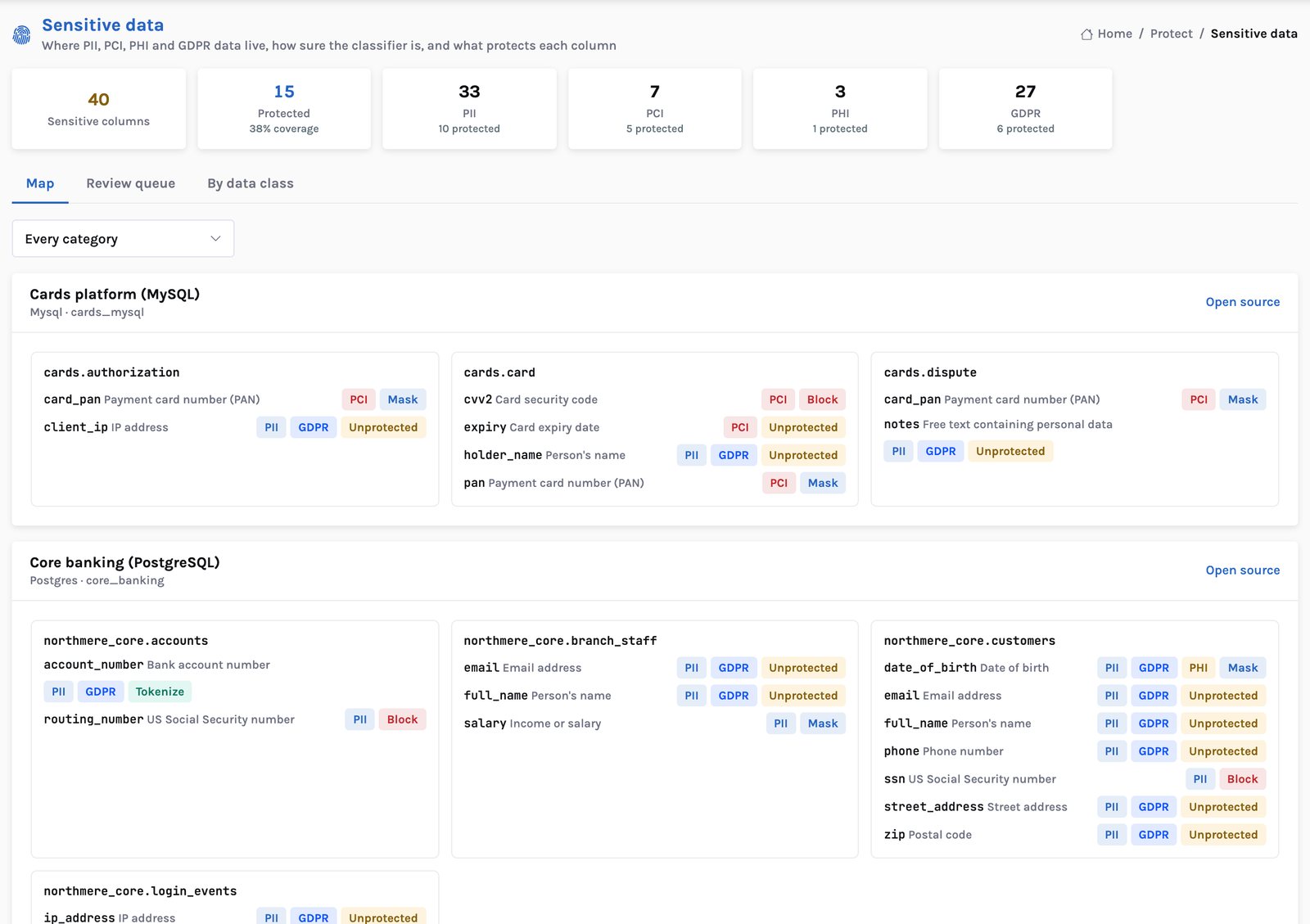
The column name is matched against patterns for each data class. A bounded sample of values is checked with validators: Luhn and issuer prefixes for cards, the SSA rules for SSNs, mod-97 for IBANs, the ABA checksum for routing numbers, ICD-10 shape, a dictionary of given names. The type rules out the impossible: a 4-byte integer is never a card number. A value score always outranks a name alone.
- PII, PCI, PHI and GDPR — each column carries its categories and what protects it
- Masked samples — a quoted sample never leaves the classifier in clear
- Values outrank names — a column whose values fail Luhn is lowered, whatever its name says
- A person’s word stays — a confirmed class is never overwritten by a re-scan
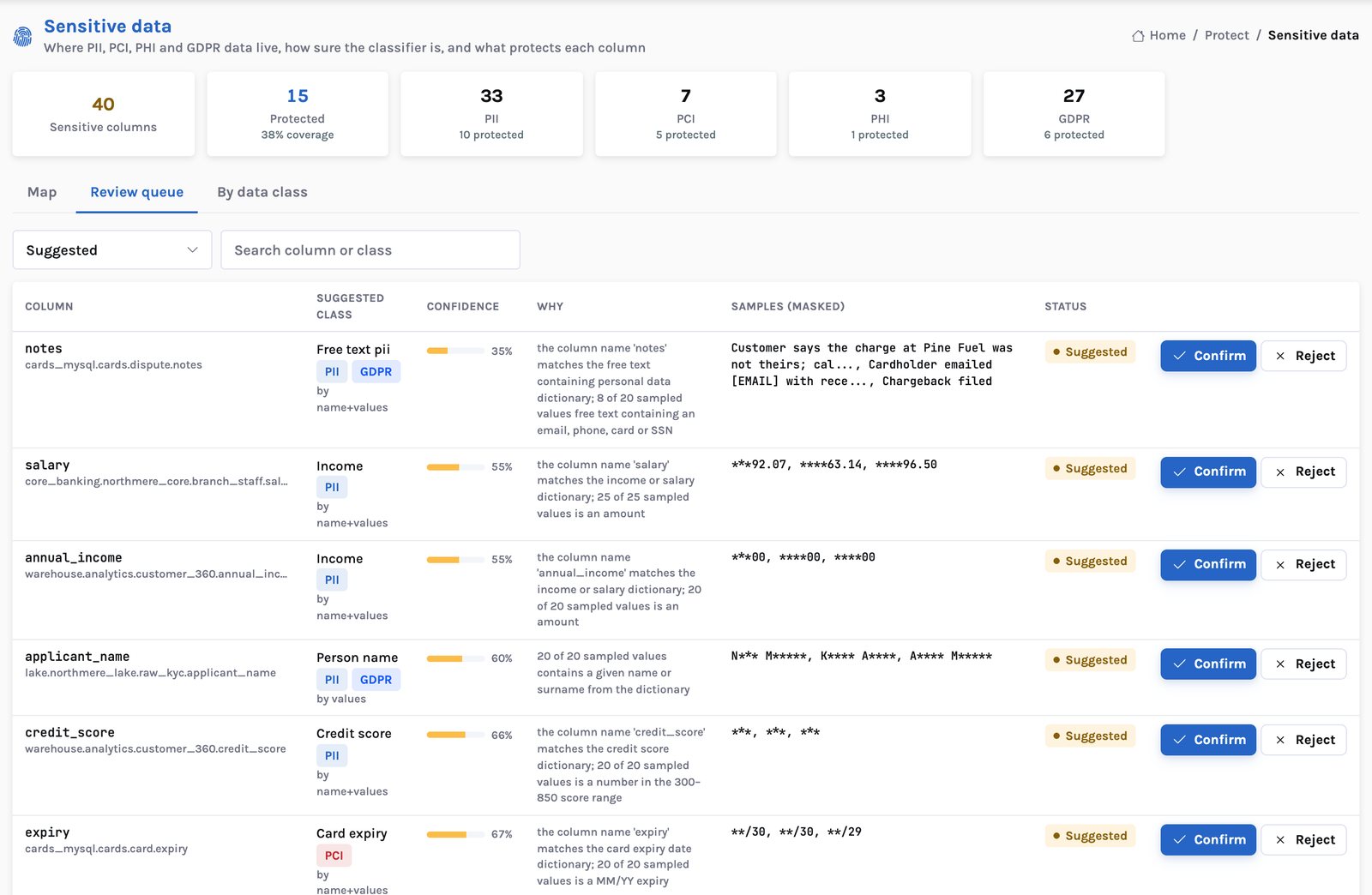
Close calls go to a person, with the classifier’s question
Person names, free text and anything between the ambiguous and confident thresholds is a suggestion, not a fact. The data classifier agent looks at each with its masked samples and prepares one classification per column; a person confirms or rejects it.
- Reasons shown — the name match, the share of values that validated, and the confidence bar
- Confirm or reject — one click each, recorded with who decided
Where people stay in charge
- The discovery scout and data classifier suggest; a person confirms every classification.
- Harvests run catalogue queries in a read-only session; credentials are secret references.