Request a demo
AI-first data security · databases, warehouses, lakes and AI agents

Every query checked. Every sensitive field protected. Every prompt scanned.

InsightAIShield finds the sensitive data in your estate, decides every query and every AI prompt with a policy engine that fails closed, rewrites the SQL so people and agents get masked, filtered or tokenized results instead of a blanket refusal, and keeps the evidence. Eight AI agents prepare the work; people decide, with four eyes.

  • Fails closed: no policy, no data
  • SQL rewritten in the source’s own dialect
  • FF1 / FF3-1 tokens and a vault
  • Four eyes on policies and revocations
InsightAIShield · Policies · SimulatorDemo data
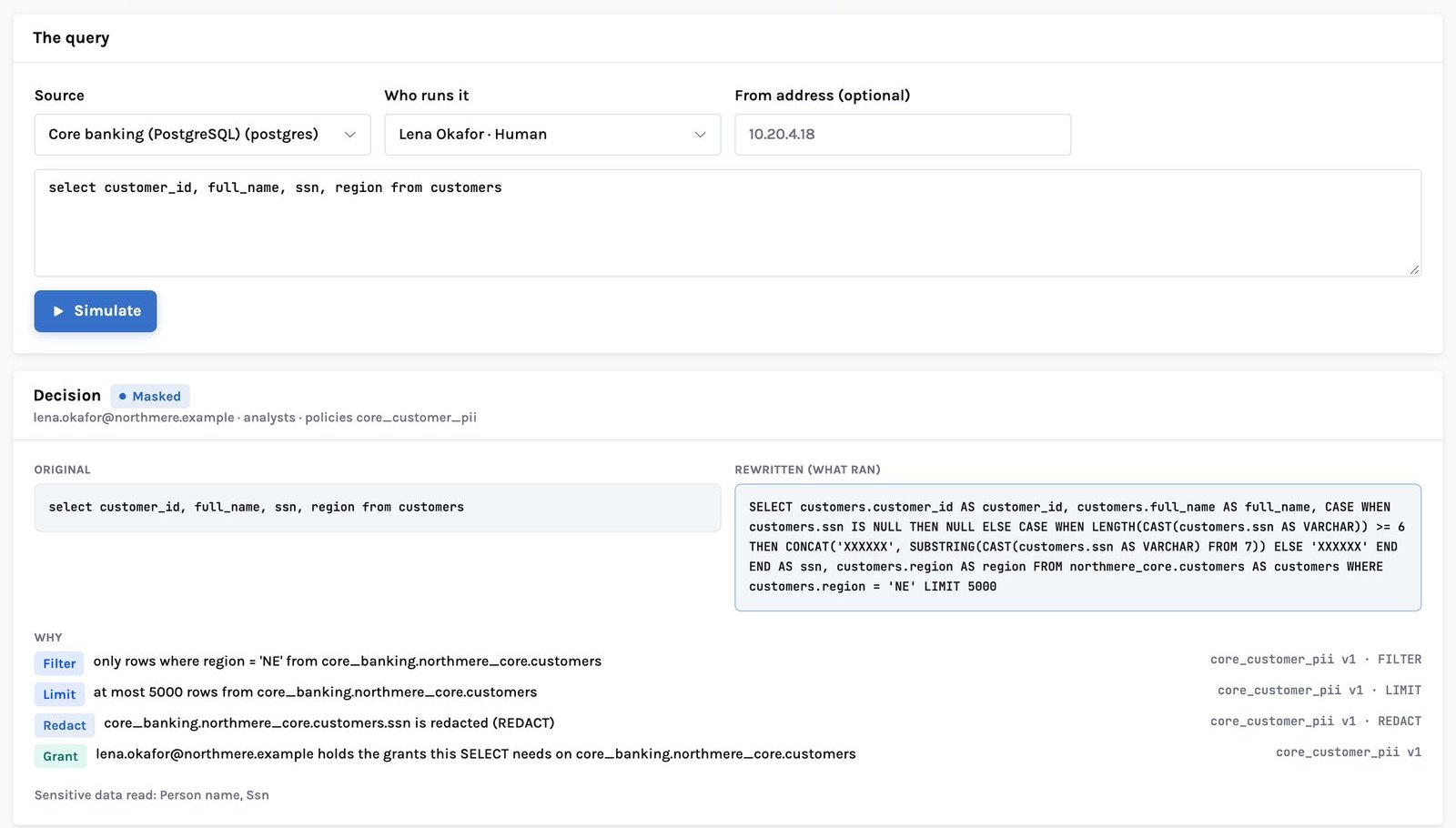
The InsightAIShield policy simulator: an analyst's query for customer IDs, names, SSNs and regions on the core banking database, decided Masked. The original SQL sits beside the rewritten SQL that ran, with the SSN redacted, a row filter to her region and a 5,000-row limit, and each reason with the policy that set it.
Where InsightAIShield decides
PostgreSQL wire proxyMySQL wire proxyQuery gateway & Python SDKAI prompt & response gatewayMCP tool checks pgaudit logsSnowflake query historyRedshift user activityCloudTrail & Athena
8 AI agents

Eight agents prepare the data-security work. People decide it.

Each agent runs as itself, in one of four phases, grounded in the engine’s records. It stops at a prepared decision you accept, reject or ask about. Every figure comes from an engine; the model only rephrases facts it was given.

Discover · 2 agents

Discovery scout

Harvests a source read-only and runs the classifier; flags sensitive columns no policy covers.

Prepares classifications to confirm and a draft protection policy

Data classifier

Looks at the close calls (names, free text) with masked samples.

Prepares one classification per column for a person
Protect · 1 agent

Policy author

Turns a plain-English request into policy YAML from the estate’s own sources, groups and data classes, then replays it on recent activity. Words it can’t match become open questions.

Prepares a policy draft; it never activates one
Detect and respond · 3 agents

Anomaly investigator

Works an anomaly against the principal’s baseline and the activity behind it.

Prepares an incident to open, or a false-positive note

Access reviewer

Compares every grant with its observed use.

Prepares a campaign of revoke, reduce and keep

Incident writer

Runs the severity engine, drafts the summary and the attestation request.

Prepares the incident for a decision
Assure · 2 agents

Compliance evidence

Maps the product’s records to PCI DSS, HIPAA, GDPR and SOC 2 controls.

Prepares the evidence pack, gaps included, for sign-off

Supervisor

Looks across the estate for what needs a person first.

Prepares the queue: unprotected data, open critical anomalies, waiting approvals
Capped at L2, “ask first”

Whatever the autonomy dial says, no agent confirms a classification, activates a policy, revokes a grant, sends a request or decides an incident. A person does, and the decision record keeps who.

The agent catalogue
Agents at work

Prepared for you: each item with the facts behind it

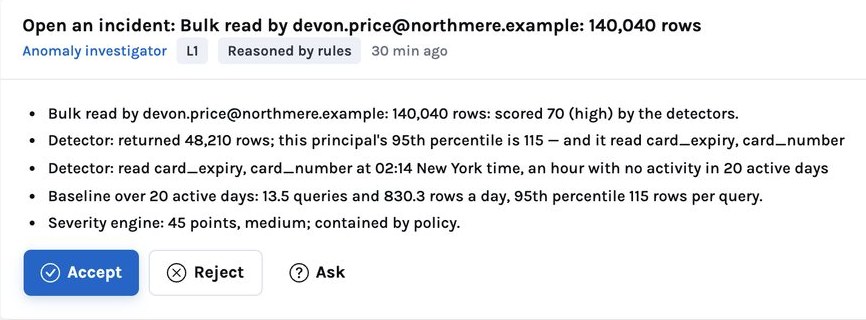
On Northmere Bank, a fictional bank, the anomaly investigator has worked each open anomaly against the principal’s 30-day baseline. Every prepared incident lists the detector’s reasons, the baseline it was scored against and the severity engine’s points, so the person deciding can check the arithmetic.

  • Accept carries it out in your name and records it
  • Reject keeps your reason; Ask leaves it open with your question
  • Model optional — with the model switched off, as in the demo, each agent runs on its rules and says so
Meet the eight agents
AI & Agents · Prepared for youDemo data
A prepared decision from the anomaly investigator: open an incident for a 140,040-row bulk read, scored 70 by the detectors, with the 95th-percentile baseline, the 02:14 off-hours read, the severity engine's 45 points, and Accept, Reject and Ask.
The data-security lifecycle

Seven steps, from the first harvest to the evidence pack

The same loop for every source: find what is sensitive, write down who may read it and how, decide every query against it, watch what happens, review what people hold, and show the auditor.

  1. 1

    Discover

    Read-only harvest of tables, columns, row counts and grants, through a secret reference.

    Discovery scout
  2. 2

    Classify

    Column names, validated sample values and types give each column a class and a confidence.

    Data classifier
  3. 3

    Set policy

    Grants and rules in YAML, simulated on recorded activity, activated by a second lead.

    Policy author
  4. 4

    Enforce

    Wire proxies, the query gateway and the AI gateway decide every query and prompt.

    The engine
  5. 5

    Monitor

    Every decision recorded; baselines per principal; detectors that show their points.

    Anomaly investigator
  6. 6

    Review

    Grants against observed use; revocations proposed by one lead and approved by another.

    Access reviewer
  7. 7

    Prove

    PCI DSS, HIPAA, GDPR and SOC 2 controls computed from the records; SIEM export.

    Compliance evidence
Rewrite, don’t just block

The analyst gets her answer. The SSNs never leave the database.

A query that reads a protected column is rewritten, in the source’s own SQL dialect, before it reaches the database: masks where the base column is read, row filters bound to the person’s attributes, and the smallest row limit that applies. What can’t be decided safely is refused, with the reason.

What Lena Okafor sent
select customer_id, ssn, region
from customers limit 3
What ran on the database
SELECT customers.customer_id AS customer_id,
  CASE WHEN customers.ssn IS NULL THEN NULL
  ELSE CASE WHEN LENGTH(CAST(customers.ssn AS VARCHAR)) >= 6
  THEN CONCAT('XXXXXX', SUBSTRING(CAST(customers.ssn AS VARCHAR) FROM 7))
  ELSE 'XXXXXX' END END AS ssn,
  customers.region AS region
FROM northmere_core.customers AS customers
WHERE customers.region = 'NE' LIMIT 3
Detect · Activity · EventDemo data
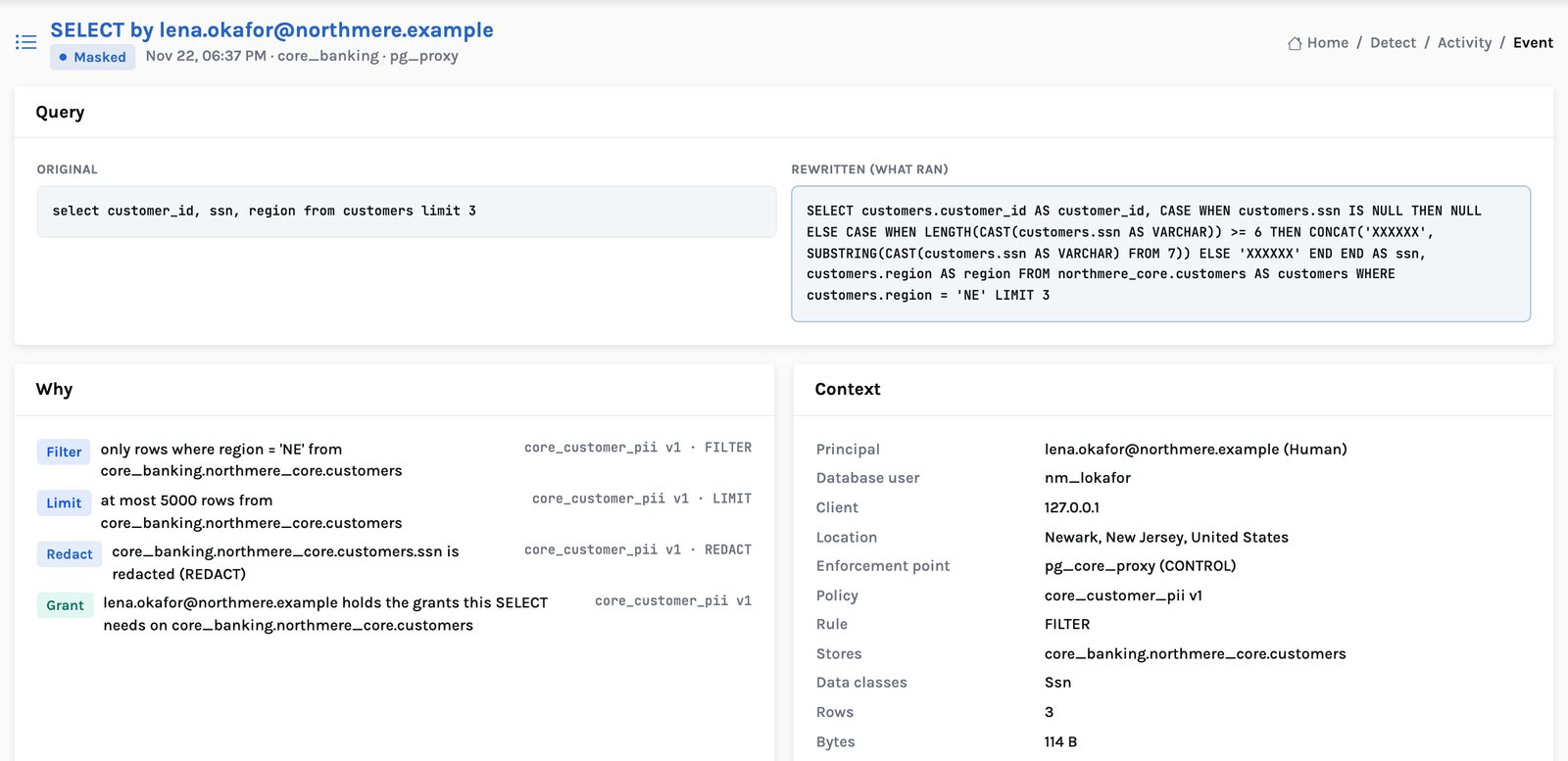
An activity event: a SELECT by an analyst through the PostgreSQL proxy, decided Masked, with the original and rewritten SQL, each reason (filter, limit, redact, grant) with the policy behind it, and the context: database user, client, location, enforcement point, rows and duration.
Every event keeps both queries and every reason. Who, from where, through which enforcement point, how many rows, and the policy version that decided.
Enforcement points

Inline, through the gateway, or from the logs you already keep

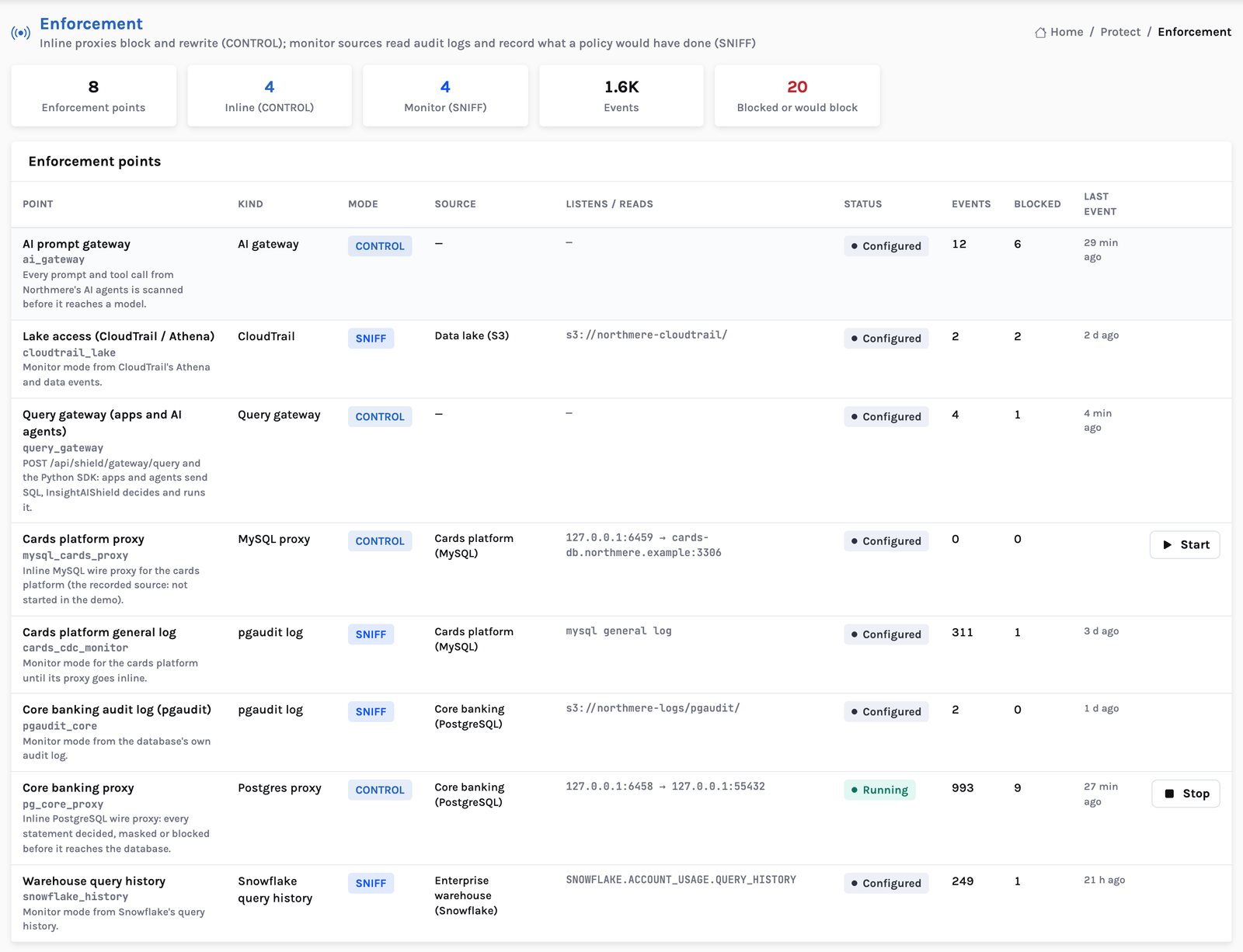
One engine decides everywhere. Choose per source whether it sits in the path (CONTROL) or reads audit logs and records what a policy would have done (SNIFF), so a policy can be proven on real traffic before it is enforced.

Inline · CONTROL

Wire-protocol proxies

PostgreSQL and MySQL clients connect to the proxy as they would to the database. Each statement is decided, rewritten or refused with an error before it reaches the source.

Inline · CONTROL

Query gateway & SDK

Apps and AI agents send SQL to /api/shield/gateway/query or through the Python SDK. InsightAIShield decides, rewrites, runs it read-only and transforms the response.

AI · CONTROL

AI prompt gateway

Prompts, responses, tool calls and tool results are scanned before they reach a model or a person; identifiers are blocked or masked by the agent’s AI policy.

Monitor · SNIFF

Audit-log monitor mode

pgaudit, Snowflake query history, Redshift user activity and CloudTrail records are decided as if they had come through a proxy. Nothing is blocked; the “would” is recorded.

Protect · EnforcementDemo data
The enforcement page: eight enforcement points, four inline and four in monitor mode, from the AI prompt gateway and the query gateway to the core banking PostgreSQL proxy and the warehouse query-history monitor, each with its source, listen address, status, events and blocks.
Masking, tokenization and AI

Protection that keeps the data useful

A token that keeps a card number’s shape still fits the column, still joins, and still shows the last four digits a support agent needs. A prompt with an SSN in it never reaches the model.

Format-preserving tokens, a vault, and audited detokenize

Vaultless FF1 or FF3-1 (NIST SP 800-38G Rev. 1) with a per-column tweak, a sealed vault with random tokens, or a one-way keyed hash. Keys stay in your secret store and are referenced, never shown.

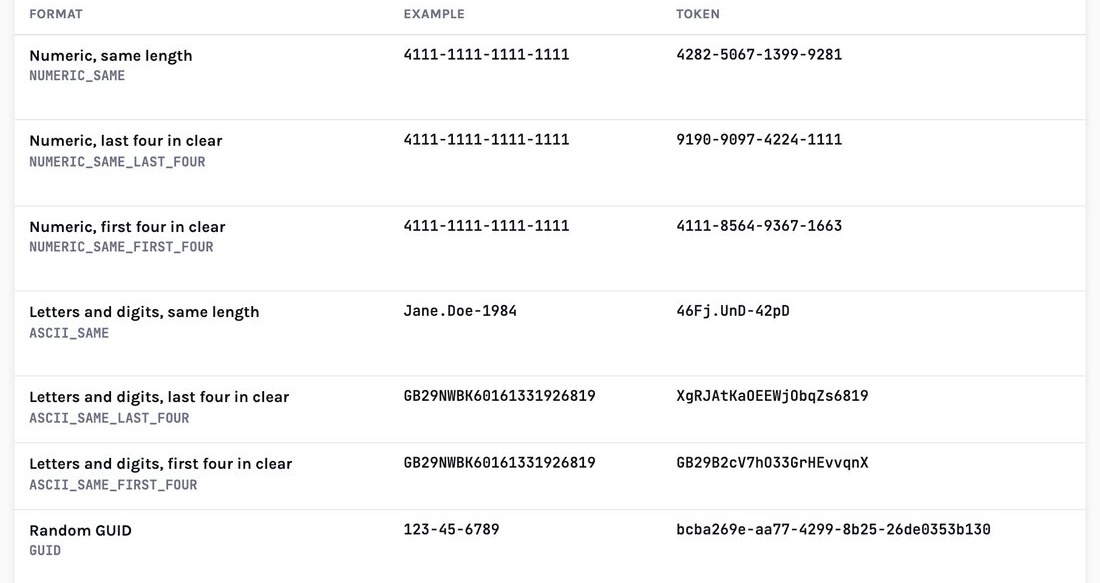
  • 7 built-in formats — same length, last four or first four in clear, letters and digits, or a random GUID; custom formats by alphabet and prefix
  • Detokenize with a purpose — every attempt recorded; the default allowance is 1,000 tokens per 60 minutes per person
  • Tokenize in the response — an AI agent asking for account numbers gets tokens with the last four kept
Masking and tokenization
Protect · Tokenization · Formats
Token formats beside an example value and its token: numeric same length, last four in clear, first four in clear, three letter-and-digit variants and a random GUID.

An AI gateway for prompts, responses and MCP tools

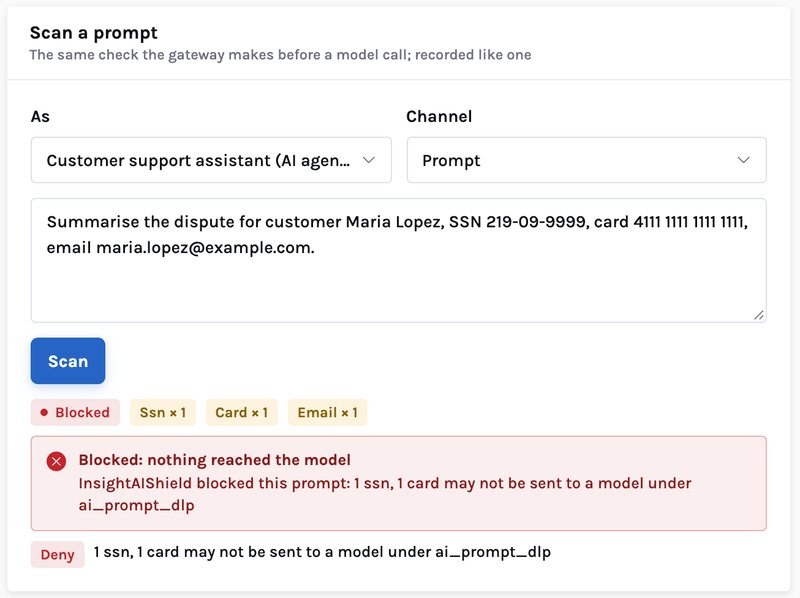
Every prompt, response, tool call and tool result from your AI agents is scanned with validators: Luhn-checked card numbers, SSA-valid SSNs, mod-97 IBANs, emails, phones, dates of birth and addresses, plus prompt-injection heuristics. The agent’s AI policy says what is blocked, what is masked, which models it may call and which tools.

  • Only the masked text is stored — never the raw prompt
  • Tools allow-listed per agent — and a tool’s SQL is decided like a person’s query
  • Fails closed — an agent no AI policy covers gets the default: cards, SSNs and IBANs blocked, the rest masked, no tools
The AI data security gateway
Protect · AI gateway · Scan a prompt
The AI gateway scanning a prompt for the customer support assistant: a dispute summary carrying an SSN, a card number and an email is blocked, so nothing reaches the model, under the default AI policy.
Activity and anomalies

A dormant DBA at 03:41 and a card export at 02:14

Each principal gets a 30-day baseline: queries and rows a day, the 95th percentile of rows per query, the hours it works, the objects it reads and the countries it connects from. Seven detectors add points, each with its reason.

Detect · AnomaliesDemo data
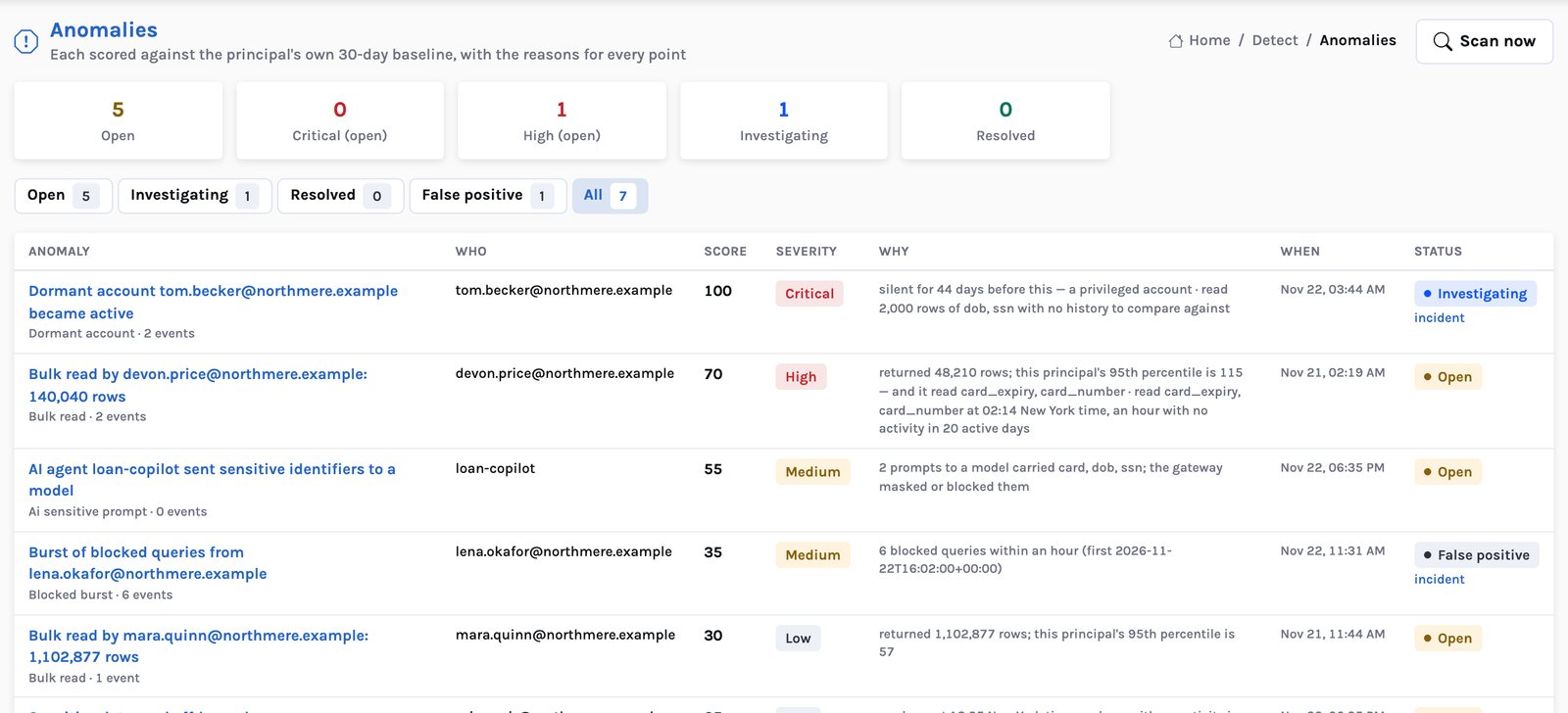
The anomalies list: a dormant account that became active scored 100 and critical, a bulk read of 140,040 card rows scored 70 and high, an AI agent sending sensitive identifiers to a model, an off-hours read, a connection from a new country, and a burst of blocked queries closed as a false positive.
Critical · incident opened

Dormant DBA account, 03:41, from abroad

A privileged account silent for 44 days reads 2,000 customers’ dates of birth and SSNs from a country it has never connected from. The severity engine adds it up:

  • Data sensitivityrestricted data read: bank account, SSN+30
  • Dormant accountan account that had been dormant+15
  • New countrya country the principal never used+15
  • Volume, off-hours, privileged10 points each+30
  • Engine → 90 points, criticalincident

The incident writer drafts an attestation request to the account holder. It stays held until a person sends it.

High · masked by policy

Bulk card export at 02:14

A card-operations analyst whose 95th percentile is 115 rows per query pulls 48,210 and then 91,830 card rows from a VPN address, an hour with no activity in 20 active days.

  • Bulk read of card dataat least 10 times this principal’s 95th percentile+45
  • Off-hourscard data read at 02:14 New York time+25
  • Contained by policycard numbers came back maskedmasked
  • Detectors → 70, high140,040 rows

The policy masked the PANs; the anomaly still needs a person to ask why. The anomaly investigator prepares the incident.

What it does

Everything between a sensitive column and the person, app or agent reading it

Each capability is in the product today, shown on Northmere Bank’s fictional data.

Discovery & classification

Read-only harvests; name, value and type signals; masked samples; a review queue for close calls.

Policy engine & simulator

19 rule types evaluated location, store, field; fail-closed; versions, diffs and replay on recorded queries.

Proxy, gateway & monitor

PostgreSQL and MySQL wire proxies, a query gateway and SDK, and monitor mode from audit logs.

Masking & tokenization

Mask, redact, hash or tokenize; FF1, FF3-1 and a vault; detokenize with a purpose, audited and rate-limited.

Activity & anomalies

Every query with its rewrite; baselines per principal; detectors with points; incidents with four eyes.

Access reviews

Grants against observed use; revoke, reduce or keep; revocations approved by a second lead.

AI data security gateway

Prompt and response DLP, model allow-lists, MCP tool policies, prompt-injection checks.

SIEM & compliance evidence

OCSF, CEF or JSON to Splunk HEC, webhooks, S3 or syslog; PCI DSS, HIPAA, GDPR and SOC 2 evidence.

Connectors

PostgreSQL, MySQL, SQL Server, Oracle, Snowflake, BigQuery, Redshift, Databricks and S3.

Compliance evidence

Controls computed from the records, never marked met without evidence

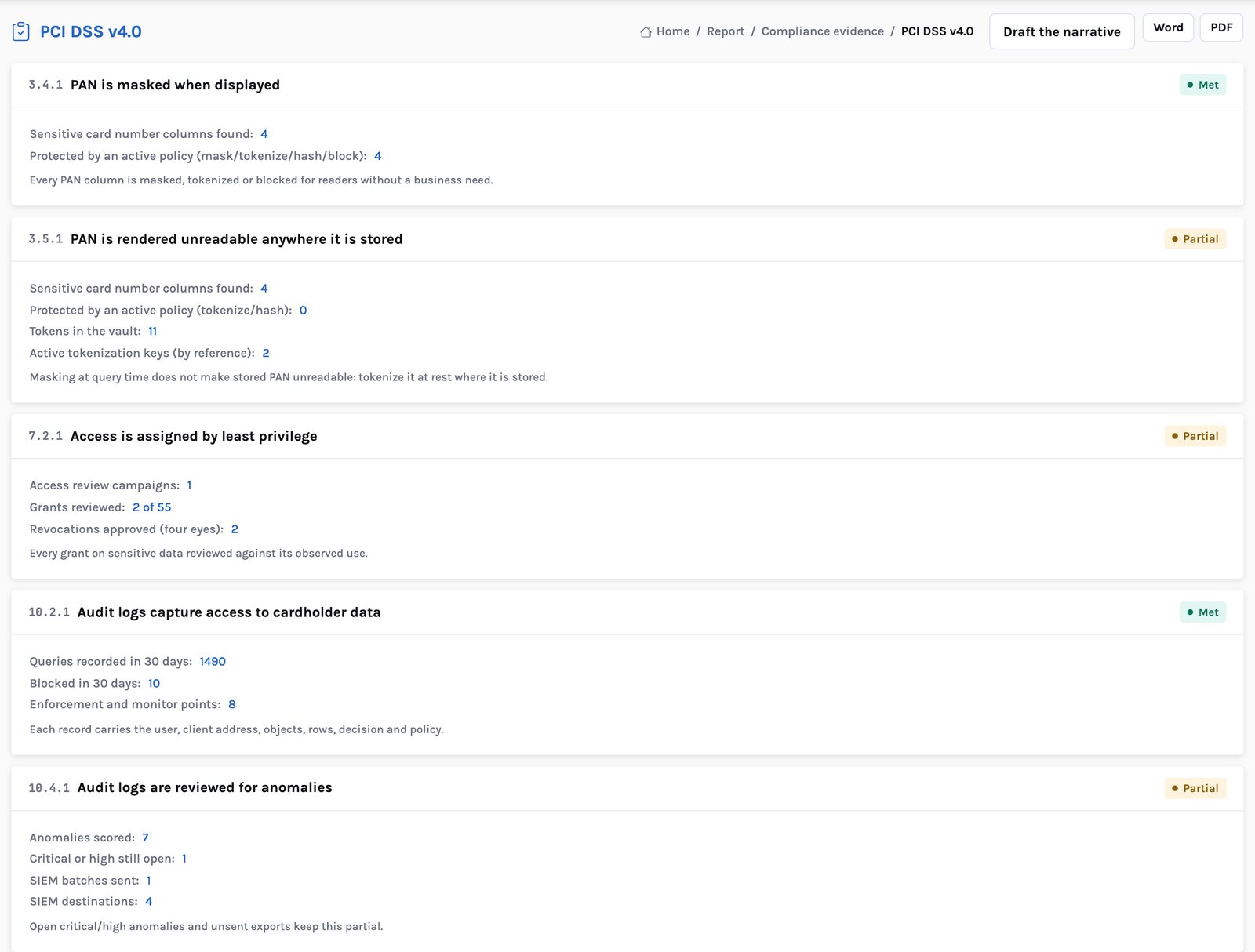
PCI DSS v4.0, the HIPAA Security Rule, GDPR and SOC 2 controls are each evaluated from what InsightAIShield records: which PAN columns are masked, who was granted what and used it, which policies a second person activated, which anomalies are still open. Where there is nothing to show, the control says partial or gap, and what would close it. Packs export to Word or PDF for the person who signs them off.

  • 4 frameworks — PCI DSS v4.0, HIPAA Security Rule, GDPR, SOC 2 Trust Services Criteria
  • A map, not a certification — an assessor decides; the pack shows the evidence and its gaps
Report · Compliance · PCI DSS v4.0Demo data
PCI DSS v4.0 controls in InsightAIShield: 3.4.1 PAN masked when displayed (met), 3.5.1 PAN unreadable where stored (partial), 7.2.1 least privilege (partial), 10.2.1 audit logs capture access (met), 10.4.1 logs reviewed for anomalies (partial), 12.10.1 incident response followed (partial) and 6.5.1 changes reviewed and approved (met), each with its evidence counts.
Deployment

Run it where your data already lives

A Python API, a React app and PostgreSQL for its own records. Connectors read through secret references; the proxies and gateways sit next to your sources.

Hosted by usCloud SaaS

The fastest start, with the proxies in your network.

Your accountAWS VPC

In your AWS account, inside your VPC.

Your tenantAzure private

In your Azure tenant, inside your VNet.

Your projectGoogle Cloud private

In your Google Cloud project, inside your VPC.

Built by VerticalServe

Part of the InsightLake suite

InsightAIShield shares its platform, identity, agents and deployment model with the other Insight products, from Millburn, New Jersey, USA and Pune, India.

66AI products
50+enterprise clients
10+ yrof data & AI engineering
3 cloudsRuns on AWS, Google Cloud and Azure

See every query decided on your own data

We walk through Northmere Bank, a fictional bank, or harvest one of your sources read-only and replay your own queries through the simulator.

Request a demo