An auditor’s request list for a data-security review is long and specific: show that card numbers are masked when displayed, show the audit logs that capture access to cardholder data, show that access was reviewed and that changes were approved. The usual answer is a fortnight of screenshots, exports and emails, assembled by someone who was not there when the work was done. InsightAIShield keeps the records the evidence comes from, so it can compute the evidence instead. This post shows how it maps its own records to 23 controls across PCI DSS v4.0, the HIPAA Security Rule, GDPR and SOC 2, why no control is ever marked met without evidence, and what Northmere Bank, a fictional bank, sees today.
In short
- Four frameworks, 23 controls. PCI DSS v4.0 (7), the HIPAA Security Rule (5), GDPR (5) and SOC 2 Trust Services Criteria (6), each mapped to what the product records.
- Computed from the records. Each control’s status is a function over the product’s own data, with the threshold written next to it: met, partial or a gap.
- Never met without evidence. Where there is nothing to show, the control is a gap and says what would close it. Each control lists the counts behind its status, with a link to the records.
- A map, not a certification. The pack exports to Word or PDF and says on its first line that it is an aid for the people who sign it off, not an auditor’s opinion.
Evidence is a by-product, if you keep the records
Most of what a data-security control asks for is a fact about records. “PAN is masked when displayed” is a question about which card-number columns an active policy masks, tokenizes or blocks. “Changes are reviewed and approved” is a question about who proposed and who activated each policy version. “Audit logs capture access” is a count of recorded queries and the points that record them. InsightAIShield already holds every one of those records, because it needs them to do its job: the sensitive-data map, the policy versions with their authors and approvers, the activity, the anomalies and incidents, the access reviews, the token vault, the AI gateway’s events and the SIEM batches.
So the compliance view does not ask anyone to upload anything. It runs one small evidence function per control over those records and reports what it found.
Every control’s status is computed from records the product already keeps.
The four frameworks at a glance

Across the four frameworks Northmere has 9 controls met, 14 partial and no gaps. That is an honest picture of a bank part-way through a programme: the controls that depend on records the product produces automatically are met, and the ones that depend on people finishing work, a review campaign, an open incident, unconfirmed classifications, are partial.
PCI DSS v4.0, control by control
Here is what each PCI DSS control looks at, and where Northmere stands:
| Requirement | What the evidence function counts | Northmere |
|---|---|---|
| 3.4.1 PAN masked when displayed | card-number columns found, and how many an active policy masks, tokenizes, hashes or blocks | Met: 4 of 4 |
| 3.5.1 PAN unreadable where stored | card-number columns tokenized or hashed at rest, tokens in the vault, active keys by reference | Partial: 0 of 4 columns, 11 tokens, 2 keys |
| 7.2.1 least privilege | access review campaigns, grants reviewed, revocations approved with four eyes | Partial: 2 of 55 reviewed |
| 10.2.1 audit logs capture access | queries recorded and blocked in 30 days, enforcement and monitor points | Met: 1,490 recorded, 8 points |
| 10.4.1 logs reviewed for anomalies | anomalies scored, critical or high still open, SIEM destinations and batches sent | Partial: 1 high still open |
| 12.10.1 incident response followed | incidents, decided with a decision record, still open | Partial: 1 of 2 decided |
| 6.5.1 changes reviewed and approved | policy versions activated, and how many by a second person | Met: 7 of 7 |
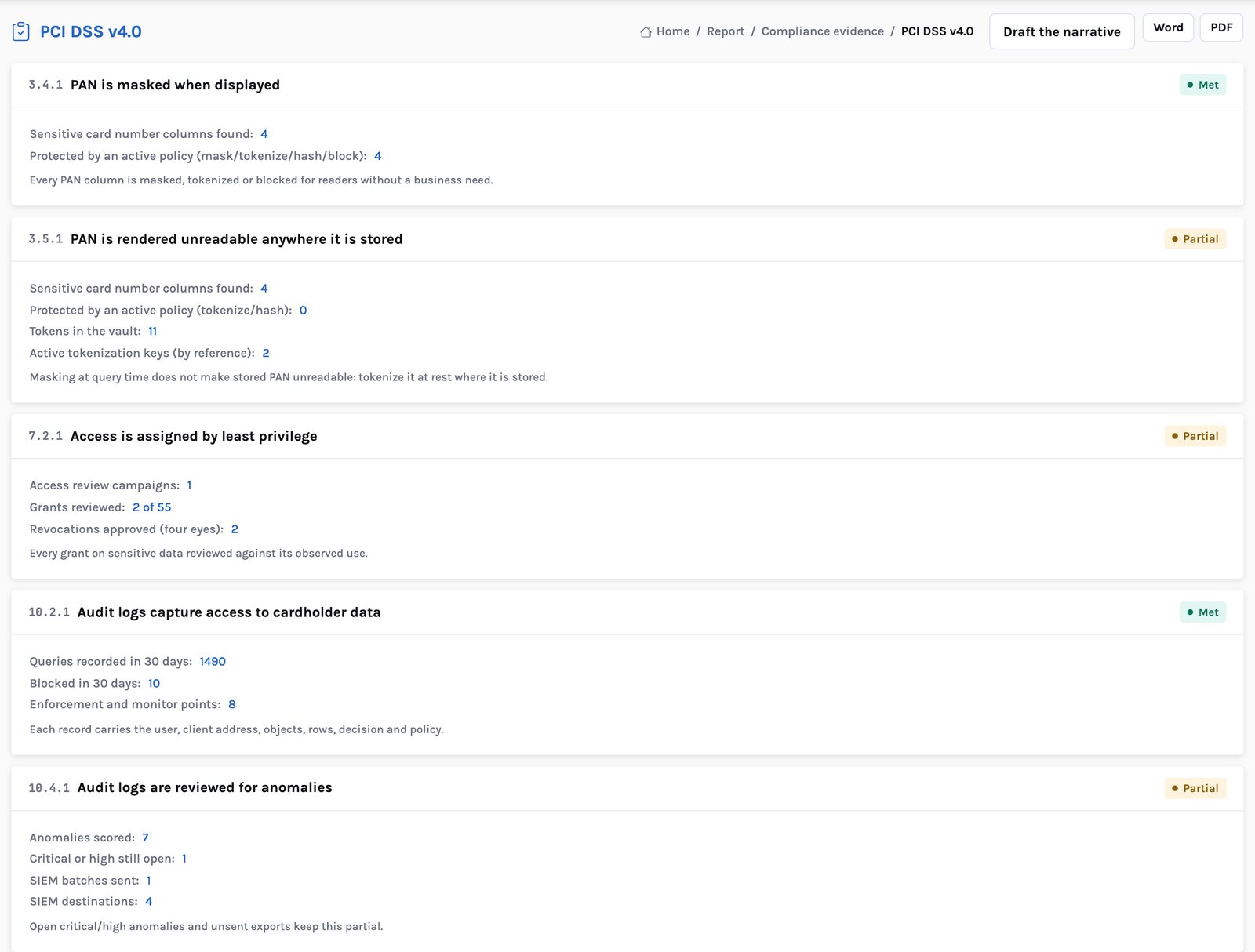
The interesting line is 3.5.1. All four card-number columns are masked when someone reads them, which satisfies 3.4.1. But masking happens at query time; the stored values are still card numbers. The evidence function for 3.5.1 only counts columns protected by tokenizing or hashing, so it reports 0 of 4 and says, in its note, what to do: tokenize the PAN at rest where it is stored. The 11 tokens in the vault and the two active keys show the tooling is in place, which is why the control is partial rather than a gap. A tool that let query-time masking count for storage would be telling the auditor something untrue.
Thresholds you can read
Each status has a rule, and the rule is in the code next to the control, short enough to quote:
- Met when every PAN column is protected (3.4.1); when every grant in the campaigns has been decided (7.2.1, CC6.1, CC6.3); when queries are recorded and at least two enforcement or monitor points record them (10.2.1); when every activated policy version was activated by a second person (6.5.1, CC8.1).
- Partial when there is some evidence but not all: a campaign open with grants still pending, an anomaly still open, an export still unsent.
- Gap when there is nothing to show at all, with a note saying what would close it.
GDPR Article 25 shows the style. It is met when at least 80% of personal-data columns are protected by default. Northmere has 27 personal-data columns and an active policy protects 6, so it is partial, and the page says why in one line.
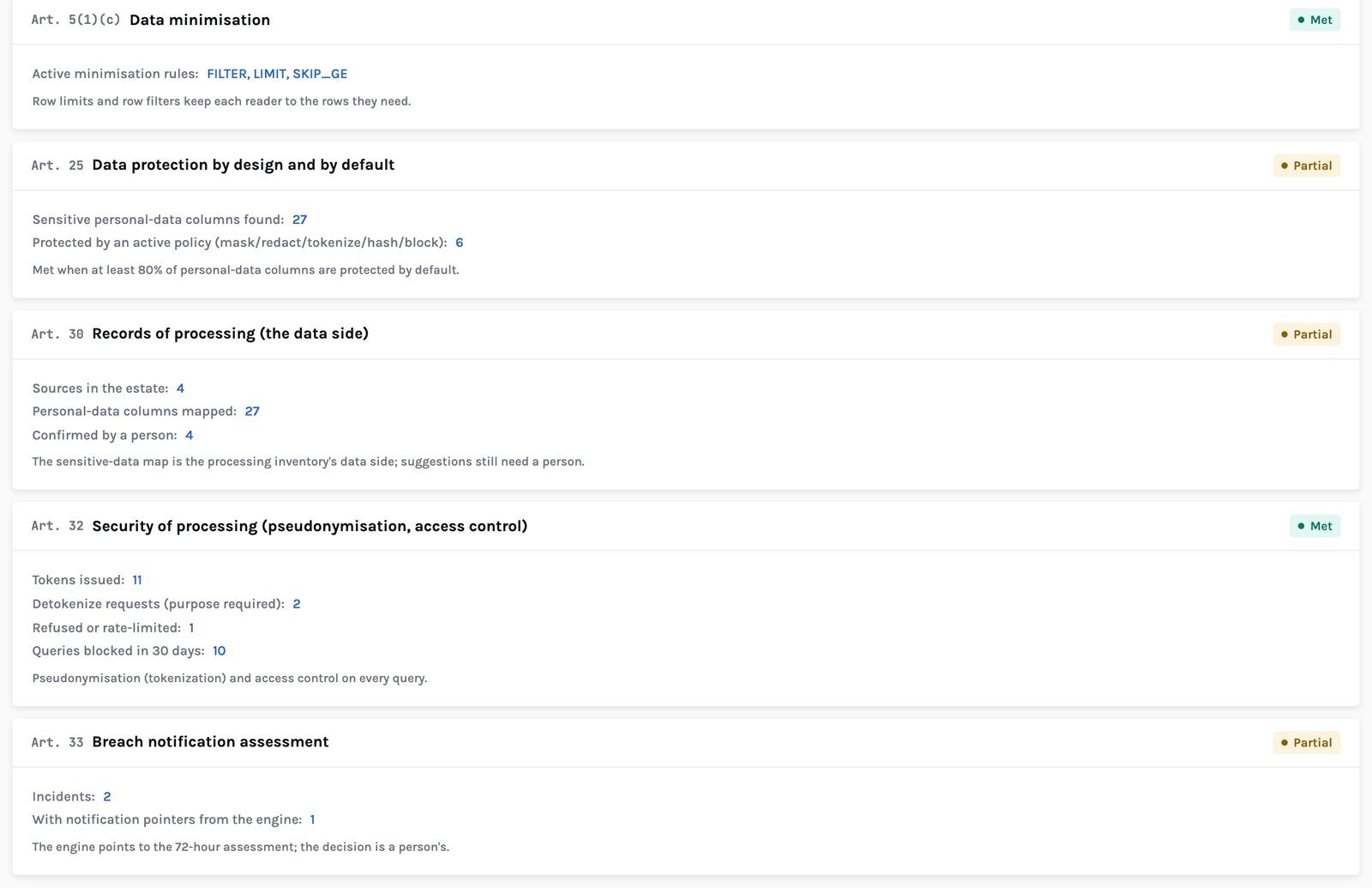
The other GDPR lines are just as literal. Article 30’s data side is the sensitive-data map: 27 personal-data columns mapped across 4 sources, 4 confirmed by a person, so partial until the rest are confirmed. Article 32 counts pseudonymisation and access control: tokens issued, detokenize requests that needed a purpose, refusals, queries blocked. Article 33 counts incidents that carry the engine’s notification pointers, the reminder to assess the 72-hour notification, and says plainly that the decision is a person’s.
One record, several frameworks
The same evidence speaks to several frameworks, and the mapping reuses it rather than asking for it twice. The access review campaign is evidence for PCI DSS 7.2.1, HIPAA 164.312(a)(1), and SOC 2 CC6.1 and CC6.3. Activity recording serves PCI DSS 10.2.1 and HIPAA 164.312(b). Policy versions with four eyes serve PCI DSS 6.5.1 and SOC 2 CC8.1. The incidents serve PCI DSS 12.10.1, HIPAA 164.308(a)(6) and SOC 2 CC7.3. And one control exists because of AI: SOC 2 CC6.7 reads the AI gateway’s events, prompts and tool calls scanned and how many were masked or blocked, as evidence that data sent to models is restricted.
| Record | PCI DSS v4.0 | HIPAA | GDPR | SOC 2 |
|---|---|---|---|---|
| Masking and tokenizing policies | 3.4.1, 3.5.1 | 164.514(b) | Art. 25, Art. 32 | — |
| Access review campaigns | 7.2.1 | 164.312(a)(1) | — | CC6.1, CC6.3 |
| Activity and enforcement points | 10.2.1 | 164.312(b) | — | CC7.2 |
| Anomalies and SIEM exports | 10.4.1 | 164.308(a)(1)(ii)(D) | — | CC7.2 |
| Incidents and decision records | 12.10.1 | 164.308(a)(6) | Art. 33 | CC7.3 |
| Policy versions with four eyes | 6.5.1 | — | — | CC8.1 |
| Row filters and limits | — | — | Art. 5(1)(c) | — |
| AI gateway events | — | — | — | CC6.7 |
From the screen to a signed pack
Every control’s status and its counts, as of now. Nothing is cached from an earlier run.
The pack for the framework with its gaps, and a drafted narrative from the numbered facts. With the model off it runs on its rules and says so.
Draft the narrative, then edit it; open any count to see the records behind it.
Word or PDF: as-of date, met, partial and gaps, then each control with its evidence and notes.
The agent can’t sign off a pack. The sign-off is recorded with the person’s name.
The pack is their starting point. Whether a control is met is their judgement.
The exported pack opens with one sentence that matters more than any table in it: prepared from InsightAIShield’s records; the mapping is an aid for the people who sign it off, not an auditor’s opinion. The compliance evidence agent never invents evidence; a control with nothing to show is a gap. Its narrative may rephrase the facts, but a sentence carrying a figure that the evidence functions did not produce is thrown away.
Using the partials as a work list
The most practical use of the evidence view is not the audit; it is the weeks before it. Each partial control names the work that would move it:
- 3.5.1: tokenize the PAN where it rests, in the lake’s card exports first.
- 7.2.1, CC6.1, CC6.3, 164.312(a)(1): finish the Q4 campaign; 53 grants are still to be decided.
- 10.4.1, 164.308(a)(1)(ii)(D): close the open high anomaly and keep releasing SIEM batches.
- 12.10.1, CC7.3, 164.308(a)(6): decide the open incident, with its decision record.
- Art. 25, Art. 30: confirm the classifier’s suggestions and extend protection to more of the 27 personal-data columns.
Each of those is a task in InsightAIShield with a person attached, and the supervisor agent already lists them on the home page as what needs a person first. When they are done, the statuses change on their own, because they were never typed in.
Evidence you compute is evidence you can trust, including when it says partial.
A pack that is all green is either a mature programme or a generous mapping. InsightAIShield computes each status from the records, shows the counts, and leaves the judgement to the assessor.
Where people stay in charge
- The compliance evidence agent prepares a pack and its narrative; a person signs it off, and an assessor decides whether a control is met.
- Every agent action is capped at L2, “ask first”: an agent prepares, and a person confirms, activates, revokes, sends or decides.
- A policy version goes live only when a second lead, not the person who proposed it, approves it.
- A revocation is proposed by one reviewer and approved by another; the REVOKE statement is kept on the record for your DBA to run.
- Detokenizing needs a stated purpose, is recorded, and is capped per person per period.
- SIEM batches and attestation requests are held until a person releases them.